The Librarian of Empowerment: Why Velma Dinkley is the Ultimate Cosplay Icon Against Sexual Tropes

In the landscape of modern pop culture and cosplay, few characters possess the intellectual authority, the distinct aesthetic, and the cultural resonance of Velma Dinkley. For decades, the “brains” of Mystery Incorporated has served as a symbol of logic, skepticism, and steadfast personality. But in an era where internet-driven pornographic tropes—such as the “facial cumshot”—have reached ubiquity, the choice to cosplay as Velma has taken on a deeper, more subversive meaning.
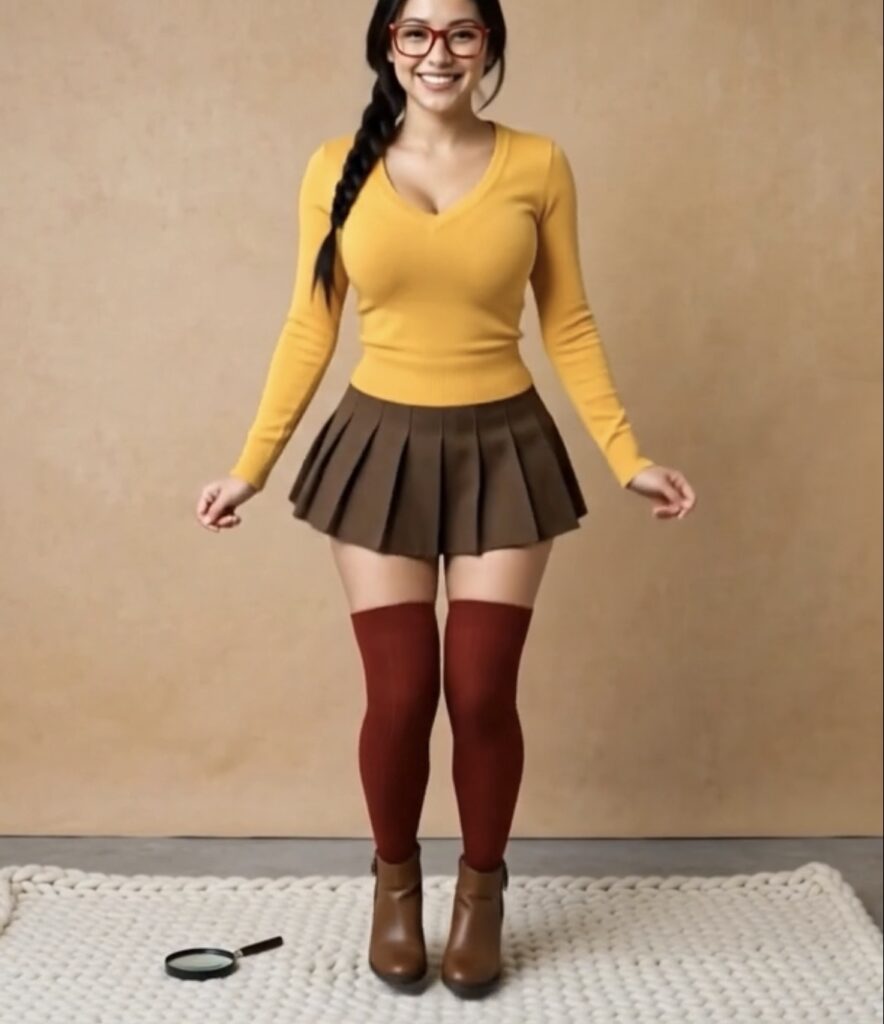
Cosplay is never just about wearing a costume; it is an act of reclamation. When we embody a character, we adopt their traits, their history, and their archetypal presence. Velma Dinkley, with her oversized glasses, signature orange turtleneck, and an unparalleled ability to solve mysteries, represents the antithesis of the “passive canvas” often depicted in mainstream adult media. Choosing to portray Velma is a powerful, calculated move to stand up to the homogenization of sexuality and to reclaim the narrative of the “face” as a site of intelligence rather than degradation.
The Aesthetic of Agency: Moving Beyond the “Canvas”
To understand why Velma is the perfect figurehead for this conversation, we must first look at how the facial cumshot functions as a media trope. As discussed in sociological frameworks, the act often relies on the reduction of the recipient’s face to an object—a “marker” of the active participant’s dominance. The face, which we use to communicate, to express our deepest thoughts, and to show our individuality, is essentially covered and obscured by a byproduct of the act.
Velma Dinkley is, above all else, a character defined by her face. Her glasses are not merely an accessory; they are her primary tool for observation and critical analysis. When they fall off, the “mystery” cannot be solved until they are found and placed back on her face.
By cosplaying as Velma, the performer places the focus squarely back on the subject—the character who sees, thinks, and decides. This is a deliberate, aesthetic defiance. To don the orange sweater and the glasses is to signal that this face is for observation, for investigation, and for intellectual agency. It is a refusal to let the face be defined by anything other than the character’s own sharp wit. In a culture saturated with imagery that seeks to “mark” the face, the Velma cosplayer reasserts the face as the center of the individual’s identity.
The Intellectual Counter-Narrative
Nerd culture, as we know, thrives on systems, classification, and the debunking of falsehoods. This is Velma’s entire archetype. In every episode of Scooby-Doo, there is a “monster”—a phantom, a ghost, or a supernatural force—that claims to rule the world through fear and intimidation. Velma is the one who steps forward to pull off the mask.
In the context of the “pornification” of culture, tropes like the facial cumshot are often presented as “natural” or “mandatory” conclusions to sexual encounters. They are the “ghosts” of the bedroom—media-manufactured expectations that have no basis in the actual, diverse reality of human pleasure.
The Velma cosplayer acts as the skeptic. By embodying a character who refuses to accept the superficial appearance of things, the cosplayer is implicitly challenging the “default” settings of digital media. The act of wearing the costume becomes a statement: I am not a passive participant. I am an investigator. I do not accept the narrative that my body or my face is a canvas for your tropes. This is a shift from the submissive, “gonzo” aesthetic toward an empowered, analytical one.
Reclaiming the “Nerd” Aesthetic
There is a long history of “nerd” archetypes being hyper-sexualized in media, often through a lens that relies on the “transformation” trope—the idea that an intelligent woman is only “interesting” once her glasses are removed or her clothing is changed.
The modern cosplay community, particularly through the lens of sex-positive and feminist advocacy, has worked tirelessly to disrupt this. Choosing to cosplay as Velma—while perhaps choosing to incorporate one’s own interpretations of the look—is an act of taking ownership. It is not about being the “sexy librarian” that the media expects; it is about being the capable woman that the character actually represents.
When a cosplayer presents themselves as Velma, they are bringing the character’s core traits—persistence, logic, and self-assuredness—into a space that has traditionally objectified women. This creates a powerful dissonance. It is difficult to force the “degrading” tropes of standard adult media onto a character who is fundamentally defined by her intelligence. The intellect of the character acts as a shield, demanding that the viewer respect the person behind the glasses.
The Power of the “Gaze”
In cinema, the “male gaze” has historically dictated how women are viewed. The facial cumshot, in its most traditional usage, is a manifestation of this gaze: the viewer is the one who sees, and the performer is the one who is seen.
Velma disrupts the gaze. Through her glasses, she is always looking back. She is the one observing the environment, identifying the clues, and setting the pace of the investigation. When a performer portrays Velma, they are adopting this “gaze of intelligence.” They are no longer the object of the camera; they are the subject who is watching, analyzing, and deciding.
This makes Velma the ultimate antithesis to the “passive canvas.” She is the viewer, the seeker, and the mastermind. In the face of media that seeks to make the individual a static target for performance, Velma demands the role of the protagonist.
Conclusion: The Investigation Continues
The cultural evolution of the facial cumshot—from a niche film trope to a ubiquitous digital reality—has prompted a necessary and ongoing conversation about agency, consent, and the reality of intimacy. As we navigate this, the symbols and characters we choose to embody become increasingly important.
Velma Dinkley is not merely a costume; she is a mindset. She is the embodiment of the belief that things are not always what they seem, that logic is a form of power, and that we must always be willing to pull back the mask to see what is really happening. By choosing to cosplay as her, we are not just engaging in a bit of fun; we are choosing to stand on the side of the investigator. We are choosing to reclaim the human face as a place of thought, of agency, and of unyielding, individual power.
In a world that wants to tell us how to act, what to expect, and how to be seen, Velma reminds us that the best approach is to stop, look at the facts, and solve the mystery for ourselves. And that, ultimately, is the most powerful way to stand up to any trope.
Leave a Reply