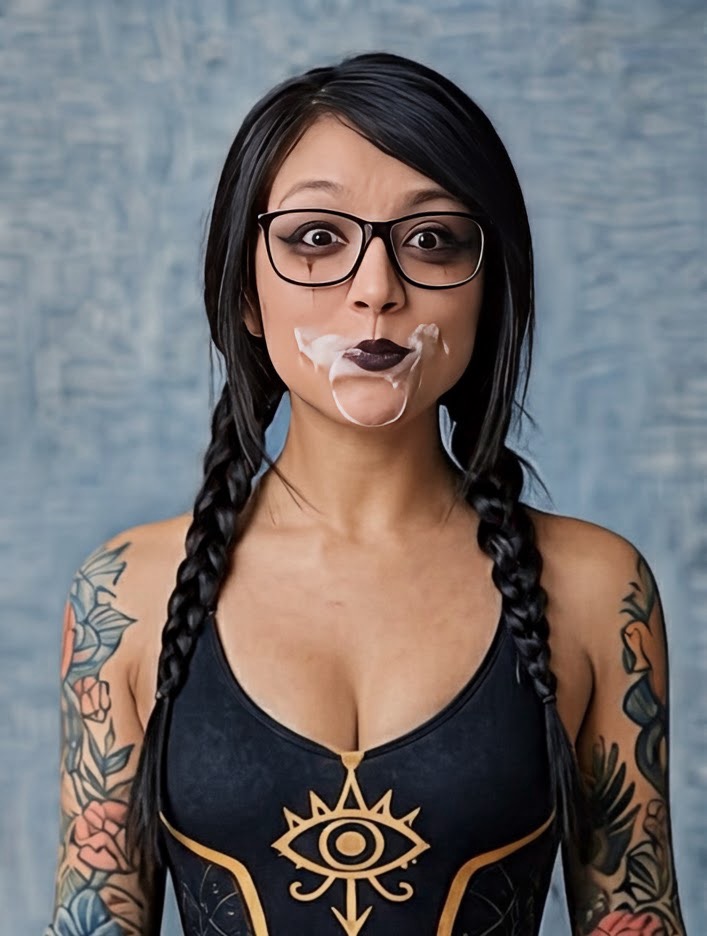
Tag: Facial cumshot

  • Sexuality in the Cosplay Community: From Facials to Foot Rubs

    Screenshot

    The intersection of cosplay and gender politics has long been a battleground for identity, agency, and bodily autonomy. What began as a niche subculture centered on sci-fi and anime fandoms has evolved into a global phenomenon where traditional boundaries of gender, performance, and sexuality are constantly rewritten. Within this vibrant ecosystem, women, non-binary, and gender-expansive creators are leveraging the transformative power of “dressing up” to actively dismantle patriarchal expectations. By embracing everything from submissive-dominant dynamics to hyper-sexualized aesthetics and fluid expressions of desire, cosplay women are not just mimicking characters—they are staging a quiet revolution in sexual liberation.
    To understand this shift, one must first recognize the historical context of the “female gaze” versus the “male gaze.” Historically, pop culture—especially comic books, gaming, and anime—has designed female characters through a lens of male consumption. Characters were hyper-sexualized, scantily clad, and physically impossible, existing primarily as visual rewards or passive love interests.
    When women first began cosplaying these characters, critics often dismissed them as victims of internalised misogyny or attention-seekers playing into those exact male fantasies. However, contemporary cosplay culture reveals a starkly different reality. Today’s creators have flipped the script, transforming the act of being looked at into an act of profound self-ownership.

    The Metamorphosis of Character Magic

    At the heart of cosplay lies what practitioners call “character magic”—the psychological threshold crossed when an individual steps into the costume, makeup, and persona of another being. For women socialized to be polite, accommodating, and physically modest, character magic acts as a permission slip to shed societal constraints.

    [Societal Expectations]  --->  [The Costume / Persona]  --->  [Character Magic Unleashed]
      • Be modest                    • Tactical armor                • Unapologetic power
      • Be accommodating             • High-femme glamour            • Boundless confidence
      • Take up less space           • Monstrous/Alien traits        • Radical self-expression

    When a woman cosplays a dominant, aggressive warrior like Eula from Genshin Impact or a morally ambiguous anti-hero like Poison Ivy, she adopts their posture, their confidence, and their unapologetic sensuality. This transformation allows creators to experiment with aspects of their personality that society routinely suppresses. The costume becomes an armor that protects the creator while granting her the freedom to take up space, express desire, and command authority.

    Reclaiming the Narrative: Performance and Fluidity

    One of the most potent ways cosplay women defy rigid gender norms is through the enthusiastic embrace of fluid sexuality and performance art. This manifest in several distinct sub-genres within the community, each pushing the boundaries of what is considered socially “acceptable” for women.

    Girl-on-Girl Cosplay and Queer Visibility

    The rise of collaborative “girl-on-girl” cosplay shoots has provided a massive platform for exploring queer aesthetics, romantic fluidity, and non-heteronormative desire. Whether portraying canonical sapphic pairings (like Korrasami from The Legend of Korra or Burbz from Adventure Time) or projecting queer subtext onto traditionally straight dynamics, these creators center female pleasure and connection.
    Crucially, this is distinct from the commodified “lesbian chic” designed for male consumption in mainstream media. In the cosplay community, these shoots are often conceptualized, directed, photographed, and edited entirely by women and queer creators. The resulting imagery emphasizes emotional intimacy, mutual desire, and a shared subversion of the traditional nuclear narrative, effectively wrestling control of queer representation away from corporate media.

    BDSM, Domination, and Sexual Autonomy

    The integration of alternative lifestyle aesthetics—specifically BDSM, leatherwork, and domination—into mainstream cosplay has skyrocketed. Characters like Makima from Chainsaw Man or Bayonetta have become cultural icons precisely because they embody absolute authority, control, and predatory sexual confidence.

    Traditional Norms                     Cosplay Reversion
    -----------------                     -----------------
    * Female submissiveness               • Direct control and dominance
    * Fear of being "too aggressive"      • Celebration of power dynamics
    * Sexual passivity                    • Intentional, structured agency

    By stepping into the role of the Dominatrix or the powerful captor, women openly reject the script of passive female compliance. They explicitly negotiate boundaries, direct the visual narrative, and showcase a form of sexuality that is aggressive, demanding, and utterly self-directed. This normalization of kink and power play within a creative medium acts as a buffer, allowing women to explore complex power dynamics safely and publicly without shame.

    Dismantling Purity Culture Through Radical Visual Content

    As the creator economy has grown, the boundaries between mainstream cosplay and adult performance have naturally blurred. Platforms like OnlyFans, Fansly, and Patreon have allowed independent models to monetize their art directly, giving them unparalleled financial independence and creative control. In this space, the subversion of gender norms takes on a explicitly radical form through the reclamation of hyper-sexualized imagery.
    Within adult-oriented cosplay, tropes historically used to degrade or objectify women are being systematically reclaimed. A prime example is the subversion of the “facials” or “cumshot” aesthetic—visuals heavily associated with traditional, male-dominated pornography where the act is often framed as a mark of submission or humiliation.
    When independent female cosplayers deliberately integrate these elements into their self-produced, highly stylized content, the power dynamic shifts entirely:

    • Financial & Creative Agency: The creator is the director, producer, and primary financial beneficiary. She is not a prop in someone else’s studio; she is an entrepreneur capitalizing on her own artistic interpretation.
    • De-stigmatization of Pleasure: By pairing high-effort, artistic costuming with explicit, taboo sexual expressions, these women bridge the gap between “high art” and “low culture.” They challenge the deep-seated societal notion that a woman cannot be simultaneously creative, intelligent, and overtly, radically sexual.
    • Deconstruction of Shame: Purity culture dictates that a woman’s value is tied to her modesty. By presenting highly explicit, taboo themes entirely on their own terms, creators strip away the weapon of stigma, transforming a historical tool of objectification into a vehicle for bodily autonomy and financial liberation.

    The Intersection of Art, Labor, and Economics

    It is impossible to discuss the sexual liberation of women in cosplay without addressing the economic structures underlying the movement. For decades, women’s labor in creative fields has been undervalued, and their sexuality heavily policed. The modern cosplay economy directly challenges both limitations.

    Aspect of ProductionTraditional IndustryIndependent Cosplay Economy
    MonetizationCorporate gatekeepers profit off female likeness.Direct-to-consumer platforms ensure creators retain up to 80-90% of revenue.
    Creative DirectionMale directors and executives dictate the boundaries of sensuality.The cosplayer decides the concept, lighting, costume design, and level of exposure.
    Body StandardsRigid, exclusionary industry standards (size, race, age).Highly diverse, body-positive community celebrating all forms of expression.
    By treating their bodies and their costumes as canvas and capital, cosplay women have built a self-sustaining ecosystem. They are artisans, wig-stylists, makeup artists, lighting technicians, and marketing executives rolled into one. This financial self-reliance grants them the ultimate leverage: the power to ignore societal demands for respectability. When a woman is financially independent through her own self-directed creative labor, the patriarchal gaze loses its ability to penalize her for stepping outside prescribed gender roles.

    Conclusion: The Costume is Just the Beginning

    Ultimately, the ways in which women utilize cosplay to explore sexual liberation are as varied as the characters they portray. Whether through the empowering psychological shift of character magic, the celebration of queer intimacy in girl-on-girl shoots, the structured authority of domination aesthetics, or the radical financial independence found in adult content creation, the message remains clear: women claim absolute ownership over their bodies, their desires, and their art.
    By occupying spaces that cross the boundaries of fantasy, reality, art, and eroticism, cosplay women are doing far more than playing a part. They are actively rewriting the rules of engagement, proving that true liberation isn’t about conforming to a new set of rules, but about having the absolute freedom to create your own.


  • World Goth Day: Sexuality and Facial Cumshots in Goth Culture

    Screenshot

    Every year on May 22nd, the international alternative community unites under a banner of dark lace, heavy eyeliner, and deep basslines to celebrate World Goth Day. What began in 2009 as a niche UK radio event has transformed into a global celebration of a 45-year-old subculture. Far from a mere appreciation for the macabre, the goth scene has historically functioned as an active critique of mainstream societal norms.
    Among the subculture’s most profound zones of rebellion is its relationship with sex, bodily autonomy, and erotic transgression. From the fishnets and corsets of the 1980s post-punk era to the highly explicit sexual dynamics of the contemporary club scene, goth culture has long positioned the physical body as a canvas for radical liberation.

    The Historical Blueprint: Sexuality as Transgression

    To understand the modern goth scene’s relationship with taboo sexual expressions, one must look to its roots in the late 1970s and early 1980s. Emerging from the ashes of British punk, early goth music icons like Siouxsie Sioux, Bauhaus, and The Cure challenged the rigid, heteronormative social standards of the era.


    Mainstream society demanded compliance, predictable gender presentations, and a sanitized, private view of human sexuality. Goth responded by thrusting the private into the public eye.


    The scene became deeply intertwined with gender-bending, androgyny, and an explicit rejection of traditional courtship. For male goths, wearing cosmetics, lace, and skirts broke the mold of aggressive, traditional masculinity. For female goths, adopting hyper-sexualized garments like waist-cinching corsets, collars, and torn fishnets was not an invitation for the male gaze; it was a subversion of it. By pairing these highly charged items with deathly pale makeup, severe hair, and aggressive body language, women inverted passive femininity into something intimidating, autonomous, and entirely self-governed.

    Kink, BDSM, and the Club Subversion

    As the subculture migrated from traditional live-music venues into the darkwave, industrial, and electronic dance clubs of the 1990s and 2000s, the aesthetic boundaries blurred further. The “Fetish Goth” substyle emerged, borrowing materials directly from BDSM communities, such as latex, PVC, harnesses, restraints, and O-ring chokers.


    The goth scene has long operated as an egalitarian safe space. Within these walls, polyamory, queer identities, and unconventional sexual practices are not merely tolerated—they are integrated into the culture’s social fabric. This environment allows participants to explore bodily limits and expressions without the moral panic or stigma enforced by the outside world.

    The Carnal Canvas: Reclaiming the Facial Cumshot

    Within the hyper-liberated, transgressive sectors of modern alternative sexuality—where goth aesthetics and hard kink heavily intersect—acts of extreme bodily fluid exchange carry a weighty symbolic significance. Among these, the facial cumshot represents a profound point of artistic and psychological exploration.
    In mainstream, commercial pornography, this act is frequently weaponized as a tool of generic degradation, often stripped of genuine intimacy or mutual power exchange. However, when brought into a subcultural space rooted in bodily autonomy and intentional kink, the act undergoes a radical transformation.


    First, it represents the subversion of shame. The gothic mindset is fundamentally obsessed with exploring what society labels unclean, macabre, or taboo. Just as the subculture finds profound beauty in decay, grief, and darkness, it actively deconstructs the societal shame associated with raw, unvarnished sexual fluids. Allowing one’s face to become the canvas for an explicit sexual act strips away the puritanical notion that the body must remain pristine or sanitized to be respected.
    Second, it acts as a form of radical trust and shared fluids. In a subculture that heavily romanticizes visceral connections—think of the enduring gothic fixation on vampirism, blood-sharing, and carnal binding—the exchange of semen directly onto the skin is viewed as an intense, unmasked display of vulnerability. It is a sensory, tactile experience that requires absolute alignment and radical trust between partners.


    Finally, it allows for the reclamation of power. Because goth culture prioritizes an active, enthusiastic approach to sexuality, the act ceases to be a passive submission to degradation. Instead, it becomes a conscious choice. For the individual receiving, it can be an act of intense, celebratory devotion, a reclamation of a highly stigmatized act, or a deliberate indulgence in the somatic weight of a partner’s climax.

    The Philosophy of the Shadows

    Ultimately, World Goth Day serves as a vital reminder that the dark aesthetic is not a mask worn to hide from reality. Rather, it is a tool used to expose the deeper truths of human nature. Mainstream culture frequently sanitizes human existence, trying to separate the elegant from the grotesque, the clean from the carnal.
    Goth culture rejects this artificial split. By embracing the full spectrum of human experience—mourning alongside dancing, and sacred intimacy alongside raw, transgressive sexuality—the scene creates a rare haven for total authenticity. Whether through the defiant wear of a leather harness or the radical vulnerability of a highly taboo sexual act, the subculture proves that there is immense freedom, autonomy, and beauty to be found within the shadows.

  • Beyond the Splash Zone: Why Euphoria’s Most Explicit Motifs Are actually Feminist Tools of Freedom

    Screenshot

    The cultural discourse surrounding Sam Levinson’s HBO powerhouse Euphoria has always been visual, polarizing, and intensely localized around the body. From its premiere, critics and audiences alike split into distinct camps: those who viewed its hyper-stylized, glitter-soaked depiction of Gen-Z teenhood as a cautionary masterpiece, and those who saw it as gratuitous, borderline-exploitative shock value.

    At the center of this debate are the show’s unapologetic, unflinching depictions of highly specific sexual acts—acts that mainstream, prestige television has traditionally left behind closed doors, or coded purely through a patriarchal lens. Specifically, the recurring motifs of oral sex, facials, and visible ejaculation (cumshots) have drawn immense fire. For traditionalist or strictly second-wave feminist perspectives, these visuals represent the ultimate capitulation to the “male gaze”—the literal and symbolic reduction of young women to passive vessels for male pleasure.

    But if we look closer—if we analyze these scenes through a sex-positive, agency-focused intersectional feminist framework—a radically different narrative emerges. In Euphoria, these acts are stripped of their sterile, algorithmic pornographic context. Instead, they are reframed as raw, messy, and deeply emotional expressions of vulnerability, intimacy, and the radical freedom to love without boundaries. By placing the narrative and bodily agency firmly back into the hands of its female and trans protagonists, Euphoria reclaims the hyper-explicit, turning tools of historical subordination into badges of emotional autonomy.

    Reclaiming the Narrative from the Pornographic Gaze

    To understand how Euphoria subverts these explicit acts, one must first understand how they function in traditional media. In standard pornography, the facial or the cumshot serves as a punctuation mark—a definitive, visual proof of male dominance and climax. The camera typically objectifies the recipient, rendering her a passive participant whose own pleasure is irrelevant to the structural economy of the scene.

    Euphoria fundamentally disrupts this economy. It accomplishes this by prioritizing what feminist film theorists call the female gaze—or more accurately, an interior gaze that emphasizes the emotional, psychological state of the character performing or receiving the act.

    When we watch Cassie Howard (Sydney Sweeney), Maddy Perez (Alexa Demie), or Jules Vaughn (Hunter Schafer) navigate their sexual landscapes, the explicit nature of their encounters is never detached from their ongoing psychological arcs. These are not nameless bodies performing scripted acts for an anonymous viewer; these are highly complex, deeply feeling young women utilizing their bodies to navigate the chaotic waters of love, validation, and self-actualization.

    Sydney Sweeney has spoken extensively about her autonomy on set and her collaboration with Levinson to ensure her sexuality felt earned and self-directed. Responding to criticisms regarding her frequent nude and explicit scenes, Sweeney explicitly defended the artistic choices:

    Screenshot

    “There are hours of discussion about what we’re doing… I’ve never felt like Sam has forced it upon me or is trying to get a nude scene into an HBO show. When I didn’t want to do a scene, he wouldn’t make me do it. It’s a completely safe, collaborative environment.”

    By establishing that the actresses themselves possess total veto power and creative input over their bodies, the show’s explicit content ceases to be an act of external exploitation. Instead, it becomes a chosen medium of performance art, allowing characters like Cassie to express an overwhelming, borderline-nihilistic desire for connection.

    The Oral Arc: Agency, Control, and Vulnerability

    In the economy of teenage relationships depicted in Euphoria, oral sex is rarely just a physical transaction; it is a battleground for intimacy and power.

    Consider Maddy Perez. In season one, Maddy’s sexual relationship with Nate Jacobs (Jacob Elordi) is wrapped in layers of performative perfectionism and toxic power struggles. Yet, when Maddy engages in sexual acts, the camera rarely centers Nate’s pleasure. Instead, it focuses on Maddy’s face—her calculating eyes, her intense expressions of control, her deliberate choices. For Maddy, weaponizing her sexuality is a form of survival in an environment that constantly seeks to diminish her. Her willingness to engage in explicit acts is not a sign of submission, but a calculated reclamation of space. It is her stating, implicitly, that she is the author of this encounter.

    Conversely, Cassie’s relationship with oral sex shifts from performative validation to a desperate, consuming hunger for love. In season two, as Cassie spirals into her secret, obsessive affair with Nate, her submissive sexual acts are framed not as degradation, but as a devastatingly raw manifestation of absolute devotion. When Cassie performs oral sex or positions herself to receive a facial, the narrative context is steeped in an almost religious fervor of surrender.

    From a radical sex-positive feminist perspective, the freedom to choose submission—to willingly offer oneself to a partner as an act of consuming passion—is just as valid an expression of bodily autonomy as demanding dominant pleasure. Cassie is choosing to love to the absolute point of erasure, and the explicit visualization of that desire honors the gravity of her emotional state. It refuses to sanitize her passion, presenting it in all its sticky, unvarnished reality.

    Jules Vaughn and the Trans-Feminist Reclamation of Intimacy

    The subversion of explicit sexual motifs becomes even more politically potent when examining the arc of Jules Vaughn, played by Hunter Schafer. As a transgender young woman, Jules’s relationship with her own body, femininity, and the desires of cisgender men is central to her character’s philosophical journey.

    In her groundbreaking special episode, “Fck Anyone Who Who计 (Part 2: Jules)”, co-written by Schafer herself, Jules explicitly deconstructs how her sexuality has been shaped by the male gaze, and how she desires to dismantle it. She notes that her entire concept of femininity had been built around what men wanted.

    Yet, throughout the series, when Jules engages in explicit sexual acts—including scenes that touch upon the mechanics of queer and trans intimacy—the show honors her bodily reality without fetishizing her. When visible male climax or explicit acts occur within her orbit, they are framed through her need for authentic validation and her deep-seated desire to be seen as a whole human being.

    Hunter Schafer has noted how deeply involved she was in crafting Jules’s sexual narrative, ensuring it moved away from standard pornographic tropes that frequently dehumanize trans women:

    “We talked about everything. Sam [Levinson] and I would sit down for hours and just talk about our lives, transness, femininity, and what it means to love. Bringing that into the sexual scenes meant they came from a place of real, lived truth, not just a fantasy.”

    When Jules engages in explicit acts with Rue (Zendaya) or even her complicated encounters with Elliot (Dominic Fike), the acts are saturated with a sense of exploratory freedom. For a trans woman, the unapologetic depiction of participating in raw, explicit intimacy—free from the violent, closeted shame of the men around her—is a profound feminist victory. It asserts her right to give and receive love in whatever physical configuration she chooses, transforming potentially objectifying motifs into expressions of divine, unfettered romance.

    The Radical Honesty of the “Cumshot” and the Facial

    Why must these acts be shown so explicitly? Why can television not simply rely on the time-honored tradition of cutting to a panning shot of the bedroom window or a discarded piece of clothing on the floor?


    The answer lies in Euphoria’s commitment to radical honesty. For Gen-Z, a generation raised in an era of ubiquitous digital pornography, smartphones, and instant access to explicit imagery, sexuality is not abstract. It is highly literal. By incorporating the visual language of the internet age—the facial, the visible ejaculation—and transplanting it into a prestige television drama, Euphoria bridges the gap between the hyper-sanitized media teens are supposed to watch and the hyper-explicit world they actually navigate.

    When Euphoria shows these fluids and these climaxes, it strips them of their clinical, exploitative isolation. It bathes them in cinematic lighting, scores them with ethereal music by Labrinth, and surrounds them with the crushing weight of adolescent heartbreak and euphoria. The show argues that these bodily fluids are not inherently dirty, shameful, or degrading. They are the physical byproducts of human connection. To view a facial or a cumshot as inherently anti-feminist is to accept the patriarchal definition of those acts—to agree that they are inherently damaging to women.

    Euphoria challenges the viewer to look past the initial shock value and ask: Why do we find the physical manifestation of male pleasure so uniquely threatening to female autonomy when the female characters themselves are consenting, active participants in the narrative?

    Conclusion: The Freedom to Bleed, Sweat, and Love

    Ultimately, Euphoria operates on the frontier of a third- and fourth-wave feminist philosophy that refuses to police women’s sexual choices. It understands that true liberation does not look like a neat, respectable, perfectly egalitarian sexual encounter where everyone sits up straight and speaks in clinical terms of consent. True liberation is messy. It is sweaty. It is occasionally self-destructive, profoundly intense, and wildly explicit.

    By allowing its actresses to collaborate on these scenes, and by centering the emotional interiority of Cassie, Maddy, and Jules, Euphoria effectively reclaims the explicit. It argues that the freedom to love means the freedom to engage in the full spectrum of human sexuality without being branded as a victim of exploitation. The facials, the oral sex, and the visible climaxes are not stains on the show’s feminist credentials; they are the ultimate proof of its radical commitment to bodily autonomy. They remind us that in the pursuit of love and ecstasy, young women have the absolute right to map their own boundaries, make their own mistakes, and find their own version of freedom in the splash zone of human intimacy.

  • Reclaiming the Splash: A Sex-Positive Feminist Defense of the Facial Cumshot

    Screenshot

    Feminist Facials

    For decades, the standard radical feminist critique of heterosexual pornography has been clear, loud, and remarkably unified. From Andrea Dworkin to contemporary anti-porn advocates, the narrative surrounding the facial cumshot—the money shot delivered to a performer’s face—has been treated as the ultimate visual symbol of patriarchal dominance. It is routinely decoded as a literal and figurative act of defacement, a manifestation of male hostility, and the ultimate reduction of a woman to a passive canvas for male pleasure.

    But sex-positive feminism, rooted in the celebration of female agency, bodily autonomy, and radical pleasure, challenges us to look closer. When we view this ubiquitous trope solely through the lens of victimization, we paradoxically repeat the patriarchal error: we strip the woman in the frame of her active consciousness, her desire, and her power.


    What if, when stripped of puritanical shame, the facial cumshot in modern porn isn’t an act of degradation at all? What if it represents something entirely different: a radical, visceral expression of intimacy, a shared celebration of male climax, and a liberated medium for expressing love?

    Moving Past the “Degradation” Reflex

    To build a positive feminist framework around this act, we have to understand why mainstream culture—and anti-porn feminism—is so intensely triggered by it. The aversion relies heavily on a deeply entrenched cultural binary: the idea that a woman’s face is the seat of her dignity and identity, while semen is fundamentally “dirty” or corrupting. Therefore, to place semen on the face is to sully the person.


    Sex-positive feminism dismantles this binary entirely. Semen is not toxic waste, nor is it a weapon; it is a natural, biological byproduct of human pleasure. When a performer actively seeks out, enjoys, and commands this specific ending to a sexual encounter, she isn’t submitting to an act of war—she is participating in an act of profound, uninhibited intimacy.


    As sex-positive feminist icon and adult industry veteran Tristan Taormino has long argued, empowerment in pornography isn’t about sanitizing sex or removing acts that make traditional society uncomfortable. It is about who holds the agency. When a woman controls the narrative of her own pleasure, acts that look transgressive from the outside can become deeply liberating expressions of raw physical connection.

    Agency from the Performers Themselves

    The most critical mistake an academic feminist can make is speaking over the actual women doing the work. When we listen to modern adult actresses, a drastically different, highly autonomous perspective emerges. Far from feeling degraded, many performers describe the facial cumshot as an active, ecstatic, and deeply validating culmination of a shared erotic journey.


    Consider the words of legendary performer and director Asa Akira. In her writing and interviews, Akira has frequently pushed back against the idea that she is a passive victim of the camera’s gaze:

    “People always ask if I find facials degrading. I don’t. To me, it’s the ultimate compliment in a scene. It’s the punctuation mark at the end of a sentence. It’s a shared climax, and there’s something incredibly intimate about holding that moment with your partner.”

    Akira’s insight reframes the act entirely. Rather than a unilateral imposition, it is a punctuation mark—a mutually understood, highly charged conclusion to a physical dialogue.


    Similarly, sex-positive activist and former adult performer Stoya has written extensively about the complex textures of desire in pornography, often noting that mainstream interpretations completely miss the emotional and sensory reality of the performers. For many women in the industry,

    witnessing their partner’s climax up close is a source of intense arousal and validation. It is an acknowledgment of their own erotic power—the reality that their body, their skill, and their presence drove their partner to the absolute peak of sexual release.


    “When we view a woman’s participation in transgressive sex acts as automatic proof of her subjugation, we aren’t protecting her—we are policing her desires under the guise of feminism.”

    The Ultimate Visual Expression of Love and Intimacy

    In heterosexual pornography, female orgasm is often easily simulated. A gasp, an arch of the back, a vocalization—all can be performed. The male climax, however, offers a rare moment of undeniable, un-faked somatic truth.


    Within a sex-positive feminist framework, the facial cumshot can be read as the ultimate manifestation of vulnerability and trust. To allow someone to ejaculate on your face requires an immense letting go of social conditioning, vanity, and physical guardrails. Conversely, for the partner, it is an act of literal exposure.


    When performed with mutual desire, this act becomes a radical aesthetic celebration of love and passion. It says: We have transcended the polite, restrictive boundaries of everyday society. We are entirely consumed by each other. It bridges the gap between the internal, invisible explosion of male pleasure and the external, shared reality of the couple. The face becomes not a site of humiliation, but a temple of shared ecstasy, safely holding the physical proof of a partner’s surrender to pleasure.

    The Anti-Porn CritiqueThe Sex-Positive Feminist Reframe
    Objectification: The performer is treated as a passive receptacle or canvas.Agency & Control: The performer is an active coordinator of the erotic finale, directing the energy.
    Degradation: Semen is used to deface and humiliate the female subject.Intimacy & Compliment: Semen is viewed as a natural symbol of peak arousal and visceral validation.
    Patriarchal Power: Reinforces male dominance over a submissive female body.Radical Freedom: Destroys puritanical shame, allowing raw, uninhibited expressions of passion.

    Reclaiming the Gaze: The Power of the Smile

    One of the most radical evolutions in modern, performer-driven porn is the subversion of the “money shot” gaze. In older, strictly male-centric porn, a facial might have been followed by a cutaway or a look of performative submission. In modern, feminist-informed, and sex-positive content, the camera frequently captures something entirely different: the post-facial smile.


    When a performer looks directly into the lens, covered in the physical evidence of her partner’s climax, and flashes a genuine, triumphant, or deeply affectionate smile, the entire patriarchal power structure collapses. She is looking back at the audience not as a conquered subject, but as a victorious deity of pleasure. She is happy, she is glowing, and she is entirely in control of her sexual reality.


    This visual moment is a declaration of independence from respectability politics. It proves that a woman can participate in the rawest, most visceral, and most taboo aspects of human sexuality without losing an ounce of her humanity, her dignity, or her feminist credentials.

    Conclusion: True Liberation Means Total Autonomy

    Feminism has never been about telling women what they should or should not find pleasurable. When we dictate that certain sex acts are inherently anti-feminist, we slide right back into the traditional patriarchal policing of women’s bodies. We imply that a “good” woman only enjoys soft, clean, vanilla intimacy—a notion that sex-positive feminists have spent more than half a century fighting to destroy.


    The facial cumshot in modern pornography, when contextualized through enthusiastic consent, performer agency, and mutual pleasure, is a boundary-breaking celebration of human connection. It is messy, it is intense, and it flies in the face of polite society—which is exactly why it is beautiful. By reclaiming this act as a valid, empowered expression of intimacy and love, we don’t just liberate the performers on screen; we expand the horizons of sexual freedom for women everywhere.

  • Facial Cumshot in Issa Rae’s “Insecure”

    Screenshot


    Introduction: The Sexplosion of Realism

    Television has spent decades carefully sanitizing, romanticizing, or outright pornographifying the physical realities of sex. For generations, intimate scenes followed a predictable, glossy grammar: soft lighting, strategic sheet placement, synchronized orgasms, and an immediate cut to post-coital cuddling with flawless makeup intact. When messiness did occur, it was almost always gendered as a male comedic failure or a tragic, non-consensual violation.


    Then came Issa Rae’s Insecure.
    In Season 2, Episode 6, titled “Hella Blows,” the acclaimed HBO comedy-drama delivered one of the most culturally disruptive, polarizing, and brilliant narrative pivots in modern television history. After attending a sex-positive convention called “Sexplosion” with her friends, a deeply confused, post-breakup Issa Dee attempts to firmly establish her “ho-phase” by initiating oral sex on her casual, old-flame partner, Daniel King (Y’lan Noel). The act goes exceedingly well—so well that Daniel ejaculates, unprompted and unexpectedly, directly into Issa’s eye.
    The resulting fallout is frantic, deeply uncomfortable, and uproariously funny. Issa screams, hurls a shirt at Daniel, and storms out of his apartment to nurse a stinging, bloodshot left eye in the backseat of a profoundly awkward UberPool.

    What could have easily been dismissed as a cheap, low-brow gag was actually a multi-layered masterclass in contemporary television writing. By analyzing the “facial scene” through a positive critical lens, we reveal how Insecure used explicit bodily fluids to construct a profound critique of the “hoe-phase” mythos, dismantle the pornographic expectations placed on modern intimacy, and affirm Black women’s bodily autonomy within the landscape of contemporary sexual politics.

    Dismantling the Myth of the Effortless “Hoe Phase”

    To appreciate the brilliance of the scene, one must understand Issa Dee’s psychological trajectory up to this point in Season 2. Devastated by the agonizingly slow dissolution of her long-term relationship with Lawrence (Jay Ellis), Issa attempts to cope using a culturally popular script: the liberated, hyper-sexual, emotion-free “ho-tation.” She constantly hypes herself up in her bathroom mirror, attempting to construct a hyper-confident, sexually dominant alter-ego who can casually collect sex partners without accumulating emotional baggage.
    However, the reality of Issa’s “hoe phase” is characterized by intense awkwardness, social friction, and emotional emptiness. She aggressively tries to seduce a neighbor who rejects her; she treats a genuinely sweet suitor named Nico with cold, transactional hostility just to prove to herself that she can treat men the way they have historically treated women. The oral sex with Daniel is meant to be the crowning achievement of this new persona—a direct application of the skills she supposedly gleaned from her sex convention.
    When Daniel finishes on her face and inadvertently blinds her left eye, the fantasy of the glamorous, detached “hoe phase” instantly shatters.


    The brilliance of the scene lies in its visceral depiction of the gap between ideological liberation and physical reality. Issa wants the reputation and the empowerment of being a sexually uninhibited “boss bitch,” but she is entirely unprepared for the actual, unvarnished physical logistics that accompany it. The fluid in her eye functions as a brilliant narrative “slap in the face.” It is a literal and figurative wake-up call that forces Issa out of her performative headspace and back into her highly sensitive, emotionally vulnerable reality. The scene masterfully illustrates that casual sex is not a frictionless, consequence-free playground; it is messy, unpredictable, and inherently exposes one’s vulnerabilities.

    Reclaiming the Gaze from Pornographic Hegemony

    One of the most radical aspects of “Hella Blows” is how it actively subverts the visual and thematic language of mainstream pornography. In the economy of modern internet pornography, the “facial” is an omnipresent, heavily monetized trope. Within that generic framework, the act is framed entirely around male pleasure, male domination, and female compliance. The recipient is expected to welcome the act with performance-ready enthusiasm, treating the bodily fluid as a cosmetic victory or a badge of sexual compliance.


    Insecure takes this deeply entrenched visual trope and views it through an unyielding, realistic female gaze.

    [ Traditional Pornographic Trope ]  --->  Framed around male pleasure & female compliance.
    [ Insecure's Deconstruction ]      --->  Reframed through a realistic female gaze: painful,
                                              unhygienic, and structurally disrespectful.

    When Daniel finishes on Issa’s face, the camera does not linger on his triumphant satisfaction, nor does it attempt to eroticize the fluid. Instead, the camera locks onto Issa’s immediate, frantic somatic response. It hurts. It burns. It is unhygienic, disruptive, and structurally jarring.


    By portraying the act as an agonizing medical emergency rather than a smooth, erotic finale, showrunner Issa Rae and director Kevin Bray strip the act of its pornographic glamour. The show boldly reminds the audience of a fundamental truth that media rarely acknowledges: semen in the human eye is a painful chemical irritant.


    By centering Issa’s pain, anger, and immediate rejection of the act, Insecure critiques the quiet ways mainstream pornography has subtly dictated the boundaries of real-world bedrooms. The scene acknowledges that many modern men have internalized pornographic scripts, assuming that their partners are “down for whatever” without requiring explicit verbal consent or checking in on real-time comfort.

    The cultural conversation following the airing of “Hella Blows” was fiercely divided, which is the ultimate marker of provocative, top-tier television. A significant portion of the audience argued that Issa overreacted. They pointed out that Daniel provided a verbal warning (“I’m gonna cum!”), that Issa continued performing the act, and that she pulled her head back at the last second, inadvertently placing her eye in the line of fire.


    However, looking closer at the writing reveals a much more insidious, brilliant layer of interpersonal micro-politics. The true damage of the scene is crystallized in the subsequent episode, when Daniel tries to defuse Issa’s lingering anger by jokingly remarking, “Guess we’re even now.”

    The Subtext of the “Even” Comment: This single line completely reframes the encounter. To Daniel, the act wasn’t just a spontaneous, uncontrollable biological accident; it was an unconscious—or perhaps semi-conscious—equalizer. It was a way to score a point against Issa for previously cheating on Lawrence with him, and then subsequently ghosting him when things got complicated.

    This dialogue elevates the scene from a simple physical mishap to a profound exploration of vengeful intimacy. It highlights how sex can be weaponized as a tool for emotional score-settling under the guise of mutual pleasure.
    Even if Daniel’s initial physical act was a clumsy accident of biology and poor spatial positioning, his retrospective framing of it as an “equalizer” highlights a profound violation of trust. It underscores the vital necessity of explicit communication regarding bodily fluids. By validating Issa’s fury, Insecure takes a firm, positive stance on sexual ethics: a verbal warning that an orgasm is imminent is not a blanket consent form to finish wherever one pleases.

    The UberPool as a Crucible of Self-Reflection

    No analysis of this scene is complete without celebrating its brilliant cinematic climax: Issa’s tragicomic ride home in an UberPool.
    Clutching a makeshift napkin-compress over her weeping, swollen eye, Issa is forced to share a cramped rideshare vehicle with total strangers while sitting in the literal and emotional residue of her failed sexual experiment. The setting is a strokes-of-genius choice by the writers. An UberPool is a hyper-modern crucible of forced public intimacy—a space where private miseries are uncomfortably squished against the mundane lives of strangers.

    Cinematic Elements of the UberPool SceneNarrative & Symbolic Function
    The Physical RestraintIssa is trapped in a moving vehicle, unable to run from her thoughts.
    The External AudienceThe silent glances of strangers mirror the judgment she fears from society.
    The Somatic VisualHer weeping, bloodshot eye physically manifests her internal emotional bruising.
    As she sits in that car, staring out the window at the Los Angeles night, the comedy completely recedes, leaving behind a profound, melancholic clarity. The weeping eye becomes an incredible visual metaphor for her internal state: she is physically bruised, emotionally overextended, and utterly exhausted by the demands of pretending to be someone she is not.
    The ride home is the turning point where Issa is forced to confront the truth that her “hoe phase” isn’t a form of empowerment or an effective shield against heartbreak; it is an exhausting, artificial performance that is fundamentally alien to her sensitive nature.

    Conclusion: The Lasting Legacy of “Hella Blows”

    Ultimately, the facial scene in Insecure’s second season deserves immense praise because it accomplished what great art is supposed to do: it provoked raw, necessary, and deeply uncomfortable conversations about topics that are normally relegated to the shadows of polite society. It forced audiences to debate the boundaries of sexual etiquette, the toxicity of uncommunicated expectations, and the difference between performative liberation and genuine personal autonomy.
    By treating a messy sexual mishap with absolute emotional gravity and sharp comedic timing, Issa Rae expanded the boundaries of what stories can be told about Black womanhood on television. She allowed her protagonist to be messy, flawed, undignified, and deeply human.
    “Hella Blows” proved that true television feminism doesn’t lie in portraying women as flawless, bulletproof icons who navigate the world with effortless grace. Rather, it lies in granting them the space to make terrible decisions, get hit square in the eye by the messy realities of life, and still have the agency to wipe themselves off, climb out of the UberPool, and figure out who they want to be on their own terms.

    Follow these 5 facial rules to avoid Issa’s fate

    3 Facial Cumshot Tips

    10 Facial Cumshot Tips

  • 5 Facial Cumshot Rules for Women: A Guide to Happy Facials

    I know that by now you’re into facial cumshots, also known as getting cum all over your face. 🌊👩🏻‍🏫 Before I get into my 5 rules, let me start by saying the biggest, overarching rule: Enthusiastic consent. Facials are fun and loving experiences for those who are loving and fun. So, before he cums on your face, make sure he likes you and wants to cum on the most beautiful part of you.

    Or if you just want to be naughty and get a facial cumshot from a guy you just met, go for it! You do you, girl!

    Rule 1: Have Fun!

    Rule 2: Close Your Eyes!

    Rule 3: Close Your Lips for More on Your Face; Open Them for More to Taste

    Rule 4: Scoop & Slurp Cleanup Method

    Rule 5: You Cum First

    Well, I hope you’ve chosen to follow my rules and enjoy your first (or 110th) cosplay facial cumshot. You are beautiful. You are loved.